The State of AI In Engineering

Everyone feels faster. Almost nobody can prove it.

AI is now part of nearly every engineering workflow, and developers say it makes them meaningfully more productive. Far fewer organizations can show what that productivity is actually worth. We surveyed 554 developers and engineering leaders to map the gap — and what to do about it.

Download the Full Report →

Read it offline, on mobile, or whenever it’s most convenient.
No spam, just a PDF in your inbox.

We respect your privacy and will never share your information.

10 min read – published July 2026 – Based on a survey of 554 developers & engineering leaders

Adoption is settled. Proof is the open question.

The debate about whether to use AI in engineering is over. Your developers are using it, and they believe it helps. The harder, more useful question for 2026 is whether you can measure what it changes — because most teams can’t yet.

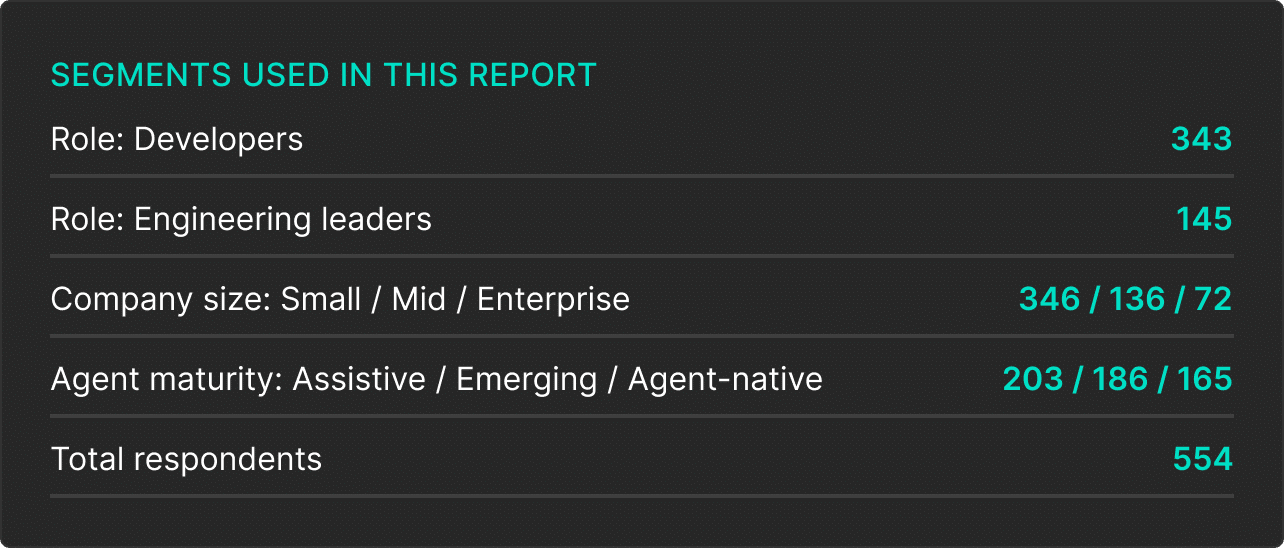
This report is based on a survey of 554 developers and engineering leaders, fielded to the GitKraken customer and user community in 2026

96.4%
of teams have adopted AI coding tools.

Only 3.6% have no one using AI. Adoption is effectively settled.

84%
of devs feel more productive with AI.

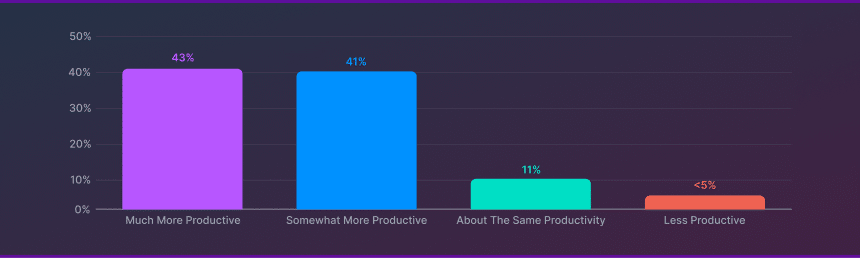
43% say "much more." Fewer than 1 in 20 feel slower. The benefit is real and widely felt.

39%
of organizations have no way to measure AI's impact.

Another 33% are still leaning on developers' self-reports.

THE AGENTIC SHIFT IS ALREADY HERE

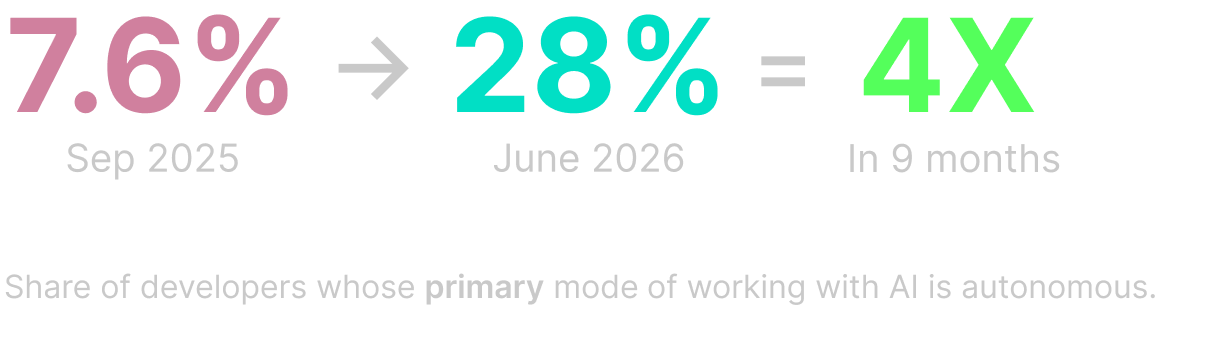
Twenty eight percent of developers’ primary mode of working with AI is autonomous. Two in three now run agents at least sometimes.

But conviction is outrunning evidence. Teams feel the speed; few can put a number on it. As agents take on more of the work, “trust me, it’s faster” gets harder to govern, and harder to fund.

AI is everywhere. Now the questions have changed.

A few years ago the open question was whether AI belonged in the development workflow. That debate is finished. In our data, AI tools are effectively universal, and the experience is overwhelmingly positive.

Developer Survey: Productivity Lift From AI Coding Tools

84% of respondents feel more productive with AI coding tools, and 43% say “much more.” Fewer than one in twenty feel it has slowed them down. When a capability is this widely adopted and this well-liked, it stops being a differentiator — for vendors and for engineering organizations alike

So the useful question is no longer “should we adopt AI?” It’s “what are the productivity gains actually worth, and can we see them?” That is where the picture gets uncomfortable — and where the rest of this report focuses.

WHAT THIS MEANS FOR YOU

“We’ve adopted AI” is no longer a story worth telling your board; nearly everyone has. The real question, from the board and the CFO, is what those gains are returning. Most teams can’t answer it yet, and the ones that can will set the terms of the conversation.

Take A Guided Tour Of GitKraken Insights →

The agentic shift is the real story

AI in engineering is not one thing. It runs from autocomplete, to asking a model when you’re stuck, to assigning whole tasks to agents, to running several agents in parallel. Where a team sits on that spectrum predicts almost everything else.

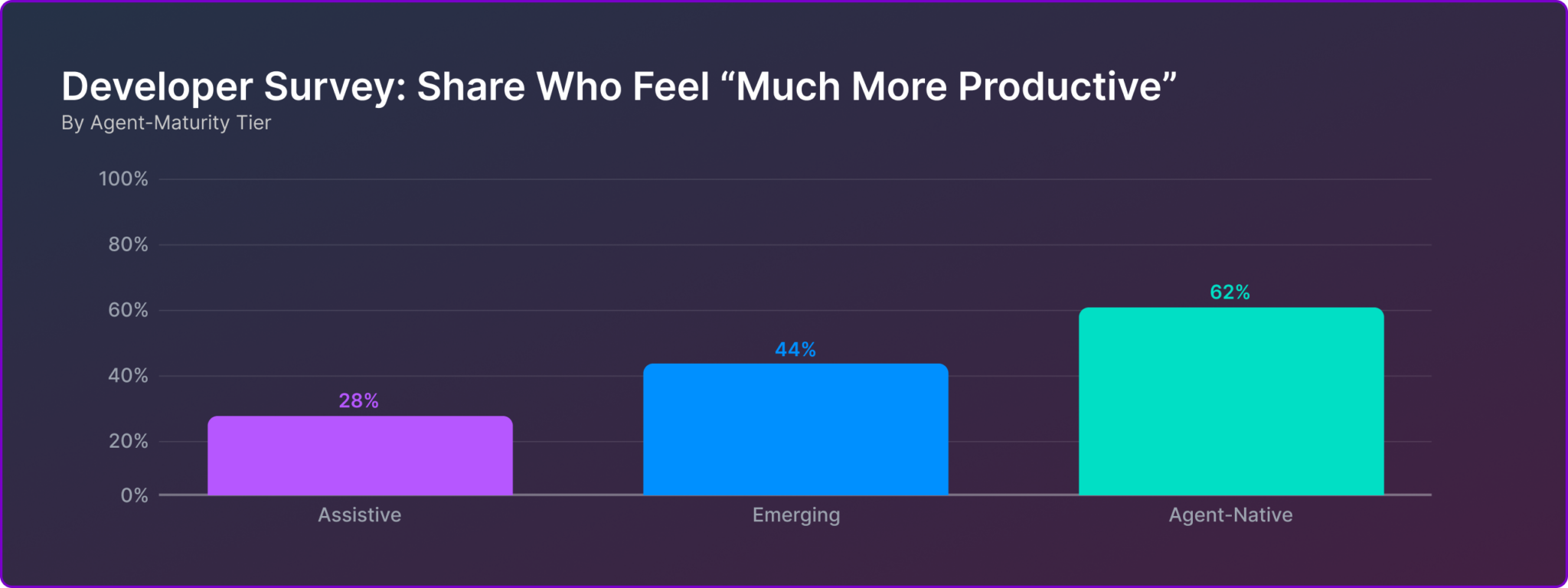
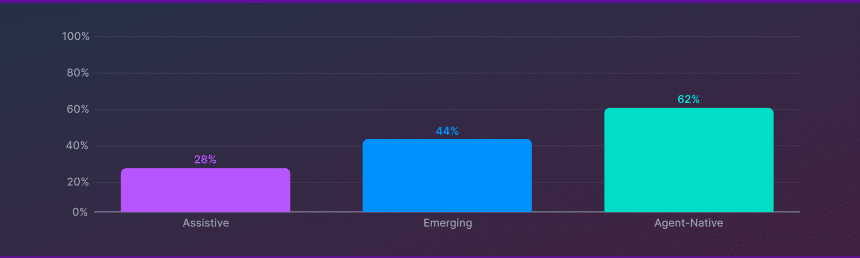
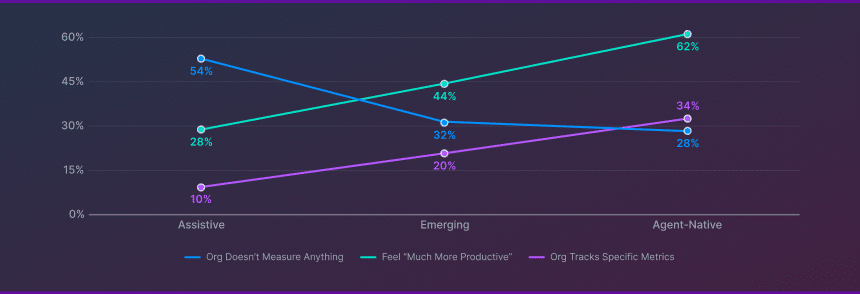
We grouped respondents into three tiers by how autonomously they use AI: assistive (no parallel agents), emerging (experimenting with agents), and agent-native (running parallel agents regularly). The payoff climbs steadily with autonomy: the share feeling “much more productive” more than doubles, from 28% of assistive users to 62% of agent-native ones.

Developer Survey: Share Who Feel “Much More Productive”

by agent-maturity tier

From Rare to Routine In Nine Months

In September 2025, just 7.6% of developers worked primarily by delegating tasks to an agent. Today 28% sit at the autonomous end of the spectrum, about 4× in nine months.

What this means for you: if your team is still living in autocomplete, that’s the low end of a fast-widening gap, and your peers are
climbing out of it.

The teams going furthest also measure the most

Adoption and measurement rise together

Agent Adoption compared with AI Measurement

by agent-maturity tier

Agent-native teams are more than three times as likely to track specific productivity metrics (34% vs. 10%), and far less likely to work somewhere that measures nothing at all (28% vs. 54%). Maturity and measurement move together: the teams pushing hardest into agents are also the ones implementing tools to understand them.

Agent-native teams are over 3 times more likely to track productivity metrics
Agent-native teams are more than three times as likely to track specific productivity metrics (34% vs. 10%), and far less likely to work somewhere that measures nothing at all (28% vs. 54%). Maturity and measurement move together: the teams pushing hardest intoagents are also the ones implementing tools to understand them.

Request A Free Trial Of GitKraken Insights

Request A Free Trial Of GitKraken Insights

Agents are becoming always-on

It’s not just whether developers use agents. It’s for how long. Agents are shifting from a tool you reach for to infrastructure that runs in the backgroundwhile you work.

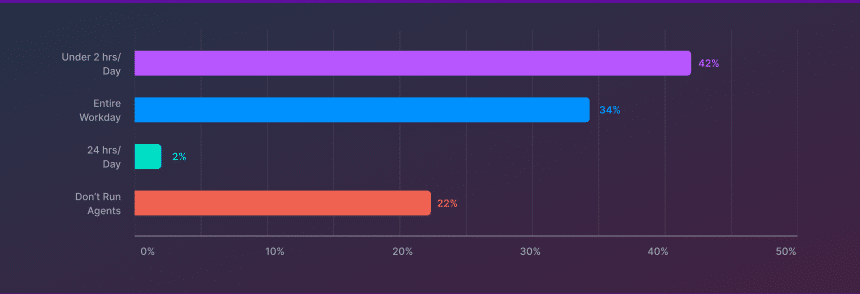
Developer Survey: How long are your agents running each day?

A third of developers (34%) keep agents running the entire workday, and another 42% run them for part of it, so more than three in four run agents during the day, and only 22% don’t run them at all. The share running agents the entire workday climbs with scale, reaching 47% in the enterprise. A small but real 2% already run agents around the clock.

A third of developers (34%) keep agents running the entire workday, and another 42% run them for part of it, so more than three in four run agents during the day, and only 22% don't run them at all. The share running agents the entire workday climbs with scale, reaching 47% in the enterprise. A small but real 2% already run agents around the clock.

WHAT THIS MEANS FOR YOU

Agents running all day aren’t an experiment anymore; they’re production infrastructure generating work continuously. That raises the stakes on the next question: if agents are shipping code while you sleep, who’s measuring what they produce, and what it costs?

Watch A Full Demo Of GitKraken Insights →

The bigger the organization, the
more agentic it is

It’s tempting to assume small, nimble teams are furthest ahead on agents. The data says the opposite: enterprises run agents the hardest, and govern and measure them most tightly as they go.

Enterprises run agents the entire workday at 47%, versus 32% of small shops. As organizations scale, structure follows as shown to the right. (Key: SmallEnterprise)

No way to measure AI impact 47%19%
Use DORA / eng metrics 6%21%
Approved tool list 25%42%
Devs choose tools alone 34%14%

WHAT THIS MEANS FOR YOU

If you run a large org and you’re not running autonomous agents yet, the data doesn’t read as playing it safe; it reads as falling behind. Your most mature peers are already there, governing and measuring as they go. “Not yet” is becoming a competitive disadvantage.

Take A Guided Tour Of GitKraken Insights →

Tool choice is a proxy for maturity

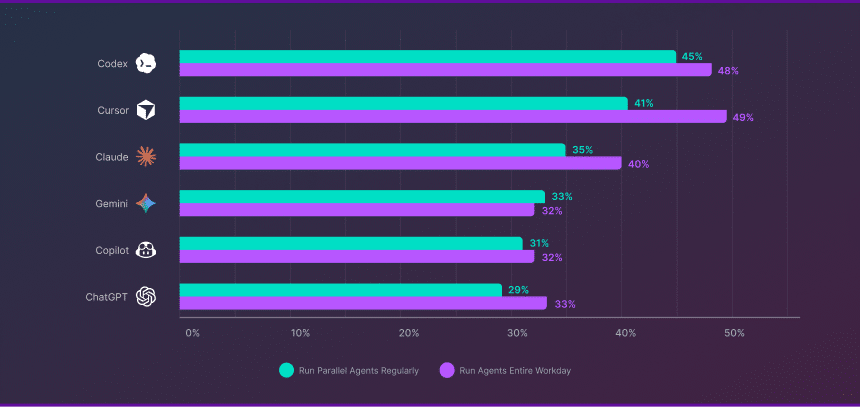
The tools developers reach for line up almost perfectly with how agentic they are, on two separate measures of agent intensity, the same tools rise to the top.

two measures of agentic intensity

by Model Used

Codex and Cursor users behave like power users, roughly 45% run parallel agents regularly and about half keep agents running all workday. Copilot and ChatGPT users skew assistive, sitting lowest on both measures; Claude Code lands in between. The tool is a free,observable signal of where a team sits on the curve.

WHAT THIS MEANS FOR YOU

If you expect your team to run autonomous agents, look hard at what you’ve actually equipped them with. The tools developers lean on for assistive work aren’t the ones associated with autonomous work. The default you standardized on a year ago may quietly be holding back the workflow you say you want.

Big teams and small teams reach for different tools

Tool choice shifts with company size

The leading tool flips with scale, which matters if you’re standardizing across an org.

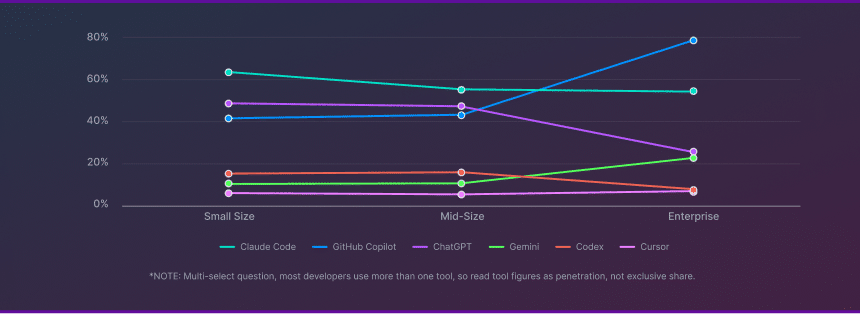
Tool penetration by company size

Claude Code leads in small (63%) and mid-size (57%) organizations. Only in the enterprise does GitHub Copilot pull ahead (74% vs. Claude Code’s 56%), and ChatGPT use drops off as organizations grow. The tool that wins on enterprise procurement isn’t always the one associated with the most autonomous work, which is worth weighing when you set a standard. Multi-select question: most developers use more than one tool, so read tool figures as penetration, not exclusive share.

Take A Guided Tour Of GitKraken Insights →

The measurement gap

Put the findings together and one gap tells the story: developers feel the value, but almost none can prove it.

two measures of agentic intensity

By Model Used

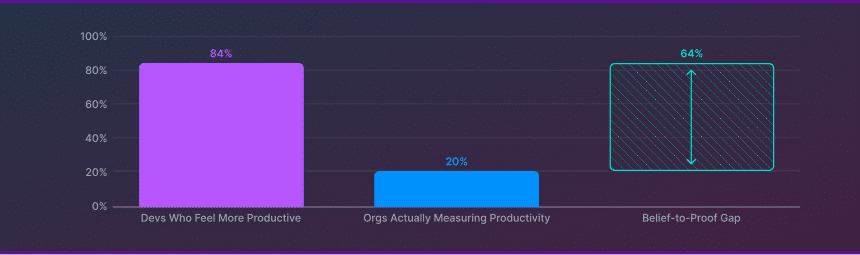
84% feel more productive, but only 20% can actually measure it. That 64-point gap between belief and proof is the real story of AI in engineering today. 39% of organizations have no way to measure AI’s impact at all, and another 33% lean on developers’ self-reports.

WHAT THIS MEANS FOR YOU

You almost certainly know how productive your team feels. You probably can’t say how productive it actually is, which means you can’t put an ROI on the AI spend in your COGS. With agents writing, reviewing, and shipping all day, “trust me, it’s faster” won’t answer what your CFO is already asking: what did this return, and which tools are worth the spend?

Four moves to close the gap

You don’t need a perfect measurement program to start. You need a baseline and a direction. Based on what the most mature teams in this survey aredoing, four moves matter most.

1. Set a baseline before you scale

Capture delivery and quality metrics now, like DORA-style throughput and stability plus code-quality signals, so you can see change instead of arguing about it. You can’t show a gain you never measured.


2. Adopt a maturity model for AI use

Treat autonomy as a ladder: assistive, emerging, agent-native, and the next frontier, agent-optimized. Know where each team sits, and make “move up a rung, and prove the result” an explicit goal rather than an accident.

3. Compare tools and models, not just adopt them

The most mature orgs don’t let everyone pick in isolation; they compare tools, and the models behind them, on output quality and cost. Knowing which model gives the best result per dollar is how you turn AI spend into return.


4. Instrument the agents, not just the people

As agents take on more work, measure their output the way you’d measure a team’s: cost, cycle time, review burden, and whether what they ship holds up. “Trust me, it’s faster” doesn’t survive a budget review.


THE MATURITY LADDER

Assistive → Emerging → Agent-native → Agent-optimized. The top rung, running parallel agents and tuning them for cost and model performance, is an emerging discipline of its own. Most teams aren’t there yet; defining how to measure it is a subject we’ll return to in a dedicated piece.

Run the work in Kepler. Prove it in Insights.

GitKraken answers both shifts in this report: Kepler is where developers run parallel agents at scale, Insights is where that work becomes measurable.

RUN THE WORK

Plan, launch and review parallel agents from one surface. Works with Claude Code, Codex, Open Code and more. Learn More About Kepler →

PROVE THE WORK

Productivity change, hours returned and the dollar value of AI-assisted capacity. The ROI number your CFO is asking for. Learn More About Insights →

turn the findings
into action.

This report surfaced two problems. GitKraken has a product for each,
and both are free to start.

kepler • for developers

Move up the maturity curve

Agent-native teams pull ahead on every outcome in this report. Kepler is how your developers get there: an agentic development environment for planning, running, and reviewing parallel agents at scale.

INSIGHTS • for leaders

Close the proof gap

72% of organizations can’t put a number on their AI ROI. Insights gives you one: agent impact, adoption, cost, and code quality, board-ready, from your own data.

Kepler runs on Windows, Mac & Linux. Insights sets up in ~15-minutes • SOC 2 Type II

Author photo

Anastasia Zamyshlyaeva

VP Engineering, GitKraken

Anastasia leads engineering at GitKraken, building developer-centric tools and platforms. Her career spans startups and enterprises, including Redpanda Data, Reltio, and McAfee, with a focus on scaling engineering organizations, improving developer experience, and bringing data-driven rigor to delivery, quality, and tooling decisions. Her current work centers on helping engineering leaders measure what actually matters as AI becomes part of everyday development.

Author photo

Jeremy Castile

VP Developer Research, GitKraken

Jeremy leads developer research at GitKraken, working to understand and amplify the voices of the 40M+ developers who rely on its tools. With experience at Docker and New Relic, and time on the engineering side himself, he bridges the gap between what developers need and what products deliver, shaping tools that make developers’ lives easier.

How we Conducted the research

This report is based on a survey of 554 developers and engineering leaders, fielded to the GitKraken customer and user community in 2026. Respondents span individual developers, team leads, engineering managers, and directors/VPs, and organizations from under 25 developers to more than 1,000. Because the survey was distributed to GitKraken’s audience, the sample skews toward developers already engaged with modern Git and engineering tooling. We’ve reported results as the share of respondents within each segment, and noted throughout where groups overlap (several questions allowed multiple selections) or where a subgroup is small enough that a figure should be read as directional.

About GitKraken

Trusted by 50M+ developers and over 100K organizations, GitKraken builds Git tools and engineering intelligence used by individuals and teams worldwide. Learn more and start measuring AI’s impact at gitkraken.com/insights.

Download the Full Report →

Read it offline, on mobile, or whenever it’s most convenient. No spam, just a PDF in your inbox.

© 2026 Axosoft, LLC DBA GitKraken

X

X

See GitKraken Insights in Action

Take an interactive tour to see how GitKraken Insights helps you quantify AI’s impact, spot bottlenecks, and prove engineering ROI.