


 GitKraken Desktop
 GitLens for IDEs
  Kepler
 GitKraken MCP
 GitKraken CLI
 GitKraken Insights
 Git Integration for Jira
 Dev Team Automations
 AI & Security Controls
 Supercharge Your Dev Team
  Secure Your Dev Team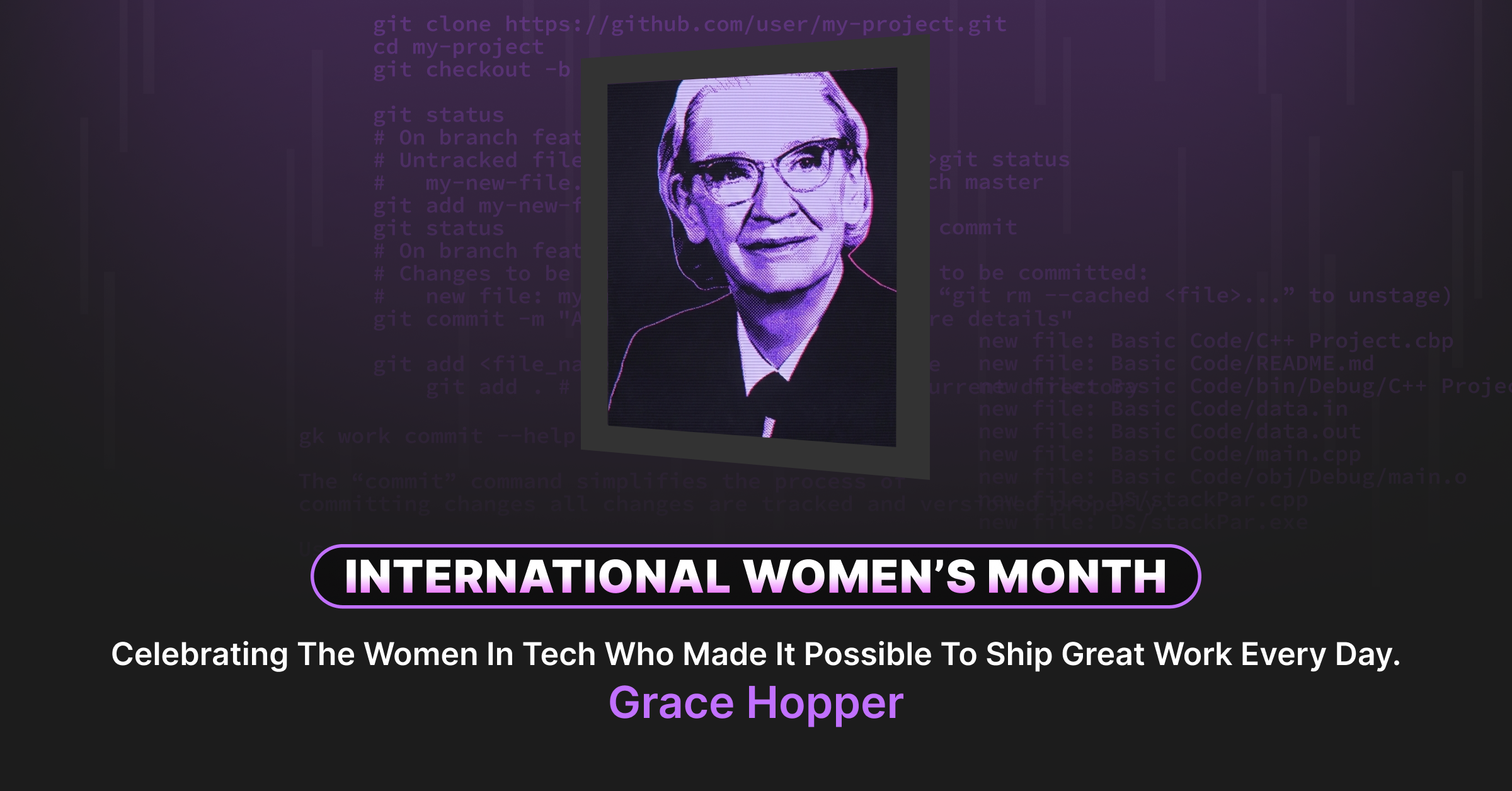

International Women’s Month gives us a reason to spotlight women whose work shaped how we build software. But the lessons from pioneers like Grace Hopper aren’t relevant just one month a year, they’re principles that should guide how we work every day. This is the first in our series celebrating women whose engineering decisions still influence your Git workflow, your deployment confidence, and how you think about developer productivity.
In 1952, Grace Hopper made a controversial claim: programmers shouldn’t have to write in machine language. The response from her peers? “Computers can’t understand English.”
She proved them wrong by creating the first compiler.
Her philosophy was simple but revolutionary: remove the friction between human thinking and machine execution. If developers spend their energy translating ideas into binary instead of solving problems, you’re optimizing for the wrong thing.
Sound familiar? That’s because we’re still fighting the same battle today, just with different tools.
The Problem Grace Solved: Translation Overhead
Before Grace Hopper’s compiler, every program was written in machine code. Developers memorized numeric operation codes. They counted memory addresses by hand. They debugged by comparing binary sequences.
The cognitive load was crushing. Not because developers weren’t smart enough, but because their tools forced them to think like machines instead of engineers.
Grace asked a better question: What if the computer did the translation work?
Her answer: COBOL (Common Business-Oriented Language). A programming language that looked like English sentences. Business logic you could read aloud. Code that non-programmers could audit.
The productivity gain? Developers stopped spending 60% of their time translating logic into machine instructions and started spending it solving actual business problems.
The confidence shift? When code is readable, you ship with certainty. When it’s cryptic, you ship with anxiety.
That’s not just a historical curiosity. That’s a pattern we see every time a tool removes unnecessary friction from a workflow.
What Modern Developers Inherited From Grace
Grace Hopper’s compiler was controversial because it felt like magic. “How can a machine write code?” skeptics asked. “That’s what developers are for.”
But Grace understood something fundamental: the best tools make complex work feel simple, not simple work feel complex.
Every high-level programming language you use today exists because Grace proved that abstraction isn’t laziness. It’s leverage.
Python exists because someone decided developers shouldn’t manually manage memory.
Git exists because someone decided version control shouldn’t require 47-step rituals.
Visual Git tools exist because someone decided you shouldn’t need to memorize command syntax to understand your repository history.
The pattern repeats: identify friction, remove it, let developers focus on craft.
The Lesson: Readability Is a Productivity Multiplier
Grace Hopper’s obsession with readable code wasn’t about “making things easier.” It was about removing barriers between intent and execution.
Here’s what that looks like in modern Git workflows:
Without readability:
- Staring at
git log --oneline --graph --all --decoratetrying to understand your branch structure - Running
git reflogto find the commit you accidentally deleted - Googling “how to undo a rebase” for the 47th time
- Shipping code with your fingers crossed because you’re not 100% sure what changed
With readability:
- Seeing your entire repository history in a visual graph
- Clicking to undo mistakes instead of Googling commands
- Reviewing changes side-by-side before committing
- Shipping with confidence because you can see what’s happening
Grace Hopper would recognize this pattern immediately: when your tools speak your language, you spend less time translating and more time building.
Grace’s Philosophy Applied to Git
Grace famously said: “A ship in port is safe, but that’s not what ships are built for.”
Modern translation: Your code is safe on your local machine, but that’s not what code is built for. It’s built to ship.
The friction between “working locally” and “deployed to production” is where most developers lose confidence. Not because the code is bad—but because the Git process is opaque.
Grace’s principle: Remove translation overhead, increase shipping confidence.
Applied to Git:
- Visual commit graphs replace memorized commands
- Interactive rebase becomes drag-and-drop instead of command-line syntax
- Merge conflict resolution shows you the actual code differences, not Git’s conflict markers
When your Git workflow is as readable as your codebase, you stop fearing deployment. You start treating shipping like the routine operation it should be.
What Grace Would Tell Modern Developers
If Grace Hopper were reviewing pull requests today, here’s what she’d say:
1. “If your tools require a manual, they’re poorly designed.”
Grace built COBOL to be self-documenting. Modern Git should be self-explanatory. If you need a cheat sheet to remember how to cherry-pick commits, your workflow has translation overhead.
2. “Optimize for the developer’s brain, not the machine’s processor.”
Grace’s compiler was slower than hand-coded assembly. She didn’t care. Developer time was more valuable than compute time. Your Git tool should optimize for your understanding, not for command-line efficiency.
3. “The most dangerous phrase in the language is: ‘We’ve always done it this way.'”
This was Grace’s most famous quote. Applied to Git: just because everyone uses command-line doesn’t mean it’s the optimal interface. Question the defaults.
4. “Make it work, then make it beautiful.”
Grace prioritized functionality over elegance. Your Git workflow should help you ship working code first, perfect code second. If your branching strategy is too complex to execute consistently, it’s the strategy that’s broken.
The Modern Parallel: Visual Git as Human-Readable Version Control
Grace Hopper created a compiler so developers could write MOVE A TO B instead of memorizing opcodes.
Visual Git tools create interfaces so developers can see their repository structure instead of memorizing graph commands.
Same philosophy. Different decade.
Here’s what human-readable version control looks like:
Command-line Git:
git log --graph --oneline --all --decorate
* 3e2f891 (HEAD -> feature) Add validation
* 7b4c023 Merge branch 'dev' into feature
|\
| * 9a1d344 (dev) Update dependencies
* | 2f8e567 Fix bug in parser
|/
* 4c9a123 (main) Initial commit
Visual Git: A graph you can actually parse in 3 seconds instead of 30.
Grace would approve. Not because visual tools are “easier”, but because they remove translation overhead. Your brain shouldn’t work to decode ASCII art. It should work to solve engineering problems.
Craft Mastery Requires the Right Abstractions
Grace Hopper didn’t dumb down programming. She elevated it.
By removing the friction of machine translation, she let developers focus on architecture, logic, and problem-solving. The craft became richer, not simpler.
Modern Git works the same way. When you can see your repository structure clearly:
- You make better branching decisions
- You write cleaner commit histories
- You resolve conflicts faster
- You ship with confidence
That’s not laziness. That’s using the right tool for the job.
Grace spent her career proving that the best engineers build abstractions that amplify human capability. Not replace it. Amplify it.
If you’re still memorizing Git commands instead of understanding your repository, you’re optimizing for the wrong thing (just like the developers who told Grace that COBOL was impossible).
The Takeaway: Remove Friction, Increase Craft
Grace Hopper’s legacy isn’t COBOL. It’s the principle behind it: developers should think like engineers, not like machines.
Every time you:
- Visualize your commit history instead of parsing logs
- Interactively rebase instead of running 6 commands
- Resolve conflicts with a visual diff tool instead of editing markers by hand
- Ship code with confidence because you can see what changed
You’re applying Grace’s philosophy. Remove unnecessary translation. Let your tools speak your language. Focus your brain on building great software, not decoding your version control system.
Grace Hopper proved that readability is a productivity multiplier. Sixty years later, we’re still learning that lesson…one workflow optimization at a time.
Ready to remove the friction from your Git workflow? See what human-readable version control looks like with GitKraken’s visual interface. Start your free trial →


 Add to Chrome
 Add to Firefox
 Add to Microsoft Edge