

 GitKraken Desktop
 GitLens for IDEs
  Kepler
 GitKraken MCP
 GitKraken CLI
 GitKraken Insights
 Git Integration for Jira
 Dev Team Automations
 AI & Security Controls
 Supercharge Your Dev Team
  Secure Your Dev Team
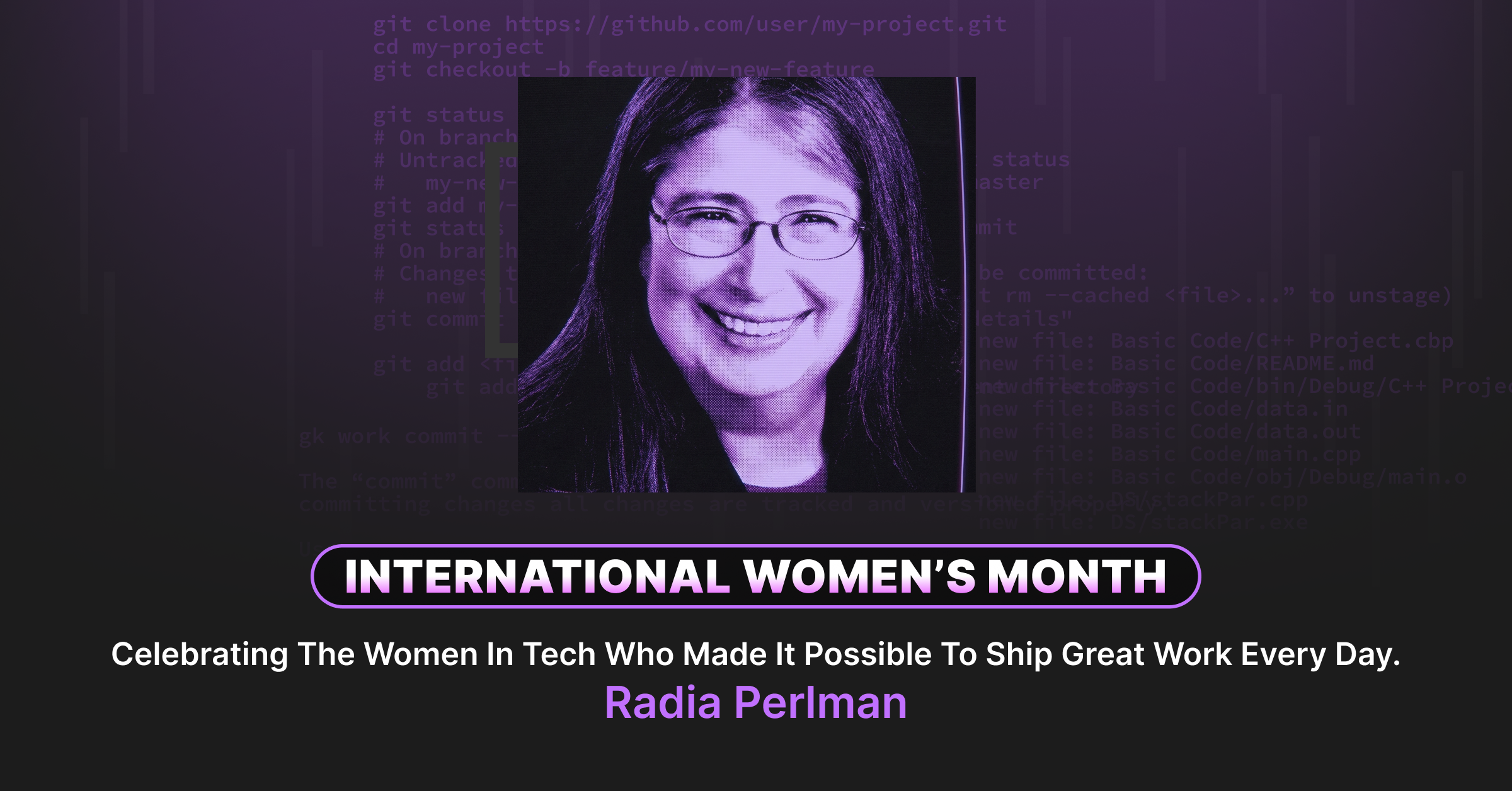

This International Women’s Month, we’re spotlighting engineers whose work you depend on daily (even if you’ve never heard their names). But recognizing women’s technical contributions shouldn’t be limited to one day in March. Radia Perlman’s Spanning Tree Protocol has kept your internet running for nearly 40 years. Her approach to building resilient systems offers lessons that apply every time you commit code, merge branches, or ship to production.
In 1985, Radia Perlman solved a problem that would have made the modern internet impossible: network loops.
Before her Spanning Tree Protocol (STP), connecting network bridges in a loop would create infinite packet storms. Data would circle endlessly. Networks would crash within seconds. The solution most engineers accepted? “Just don’t create loops.”
Radia’s response: “That’s not a solution. That’s a constraint.”
She built a protocol that made networks self-healing. Loops could exist without breaking everything. Networks became resilient by design, not by careful avoidance.
Her approach: engineer systems that recover from mistakes automatically, instead of demanding perfect execution from humans.
If that sounds relevant to your Git workflow, keep reading.
The Problem Radia Solved: Fragility Masquerading as Best Practice
Early network architects treated loops like fatal errors. “If you create a redundant path, the network dies. So don’t create redundant paths.”
This wasn’t engineering. It was risk avoidance disguised as design.
The real problem: networks were fragile because they required perfect topology management. One wrong connection and the entire system collapsed. Engineers spent more time preventing disasters than building features.
Radia saw the deeper issue: a system that can’t tolerate common mistakes is poorly designed.
Her Spanning Tree Protocol did something radical: it assumed mistakes would happen. Redundant connections would exist. Loops would form. And the network should handle it gracefully.
The result? Networks that recovered from errors in seconds instead of crashing. Engineers who stopped living in fear of topological mistakes. Infrastructure that scaled because resilience was built in, not bolted on.
The lesson for developers: If your workflow breaks when you make a common mistake, the problem is the workflow, not you.
What Modern Developers Can Learn From Spanning Tree
Radia Perlman’s protocol wasn’t just about preventing loops. It was about designing systems that assume human error and recover automatically.
Here’s the parallel to Git:
Git without resilience:
- One wrong rebase and your branch is corrupted
- Accidentally force-push and your team’s work disappears
- Merge to the wrong branch and you’ve introduced bugs to production
- Make any mistake and you’re Googling “how to undo” for 45 minutes
Git with resilience:
- Visual graph shows you what will happen before you execute
- Undo button reverses mistakes in one click
- Branch protections prevent catastrophic errors
- Merge conflict tools show you exactly what’s different
Radia’s principle: Build systems where mistakes are recoverable, not catastrophic.
When your Git workflow has built-in resilience, you stop treating version control like a minefield. You start treating it like a tool that works for you, not against you.
The Engineering Philosophy: Design for Recovery, Not Perfection
Radia Perlman once said: “The algorithms I design are intended to work even when things go wrong.”
That’s not pessimism. That’s pragmatic engineering.
Modern Git workflows fail this test constantly. They’re designed for experts who never make mistakes. Everyone else lives in constant anxiety.
Example: The Rebase Disaster
In a fragile Git workflow:
- You rebase your feature branch
- Realize you rebased the wrong commits
- Your commit history is now corrupted
- You spend 2 hours Googling recovery commands
- Eventually give up and re-clone the repo
In a resilient Git workflow:
- You rebase your feature branch
- See the visual preview before executing
- Notice the wrong commits are selected
- Adjust the selection
- Execute with confidence
Radia’s approach: The system should catch your mistakes before they become disasters, not punish you after.
Resilience = Confidence = Velocity
Here’s what Radia understood that most tool builders miss: resilient systems make teams faster, not slower.
When networks could tolerate loops, engineers stopped spending 40% of their time preventing topological errors. They spent it building features instead.
When Git workflows have built-in guardrails:
- Developers stop treating every commit like a high-wire act
- Teams ship faster because fear of mistakes is gone
- Junior developers ramp up faster because mistakes aren’t catastrophic
- Code review focuses on logic, not “did you mess up the rebase?”
The productivity equation:
- Fragile workflow = Slow execution + High anxiety + Recovery time
- Resilient workflow = Fast execution + Low anxiety + No recovery needed
Radia proved this with networks. We’re still learning it with version control.
The Spanning Tree Mindset Applied to Git
Radia’s protocol works by constantly monitoring the network and disabling redundant paths when they create loops. It’s active, not passive. It adapts, not restricts.
Applied to Git workflows:
Passive restriction (fragile):
- “Don’t ever force-push to shared branches”
- “Never rebase after pushing”
- “Always squash before merging”
- Result: Developers tiptoe around Git, afraid of breaking rules
Active resilience (robust):
- Branch protection prevents force-push disasters automatically
- Visual graph shows the impact before you execute
- Undo/reflog integration lets you reverse mistakes
- Result: Developers use Git confidently because mistakes are recoverable
Radia’s insight: Rules that depend on perfect human behavior will always fail. Systems that adapt to human behavior will always succeed.
What Radia Would Tell Modern Developers
If Radia Perlman were reviewing your Git workflow, here’s what she’d ask:
1. “Can your workflow recover from common mistakes?”
If the answer is “yes, but you have to Google the recovery command,” that’s not recovery. That’s triage.
Real recovery is built-in. One click. No manual required.
2. “Are you designing for experts or for humans?”
Radia designed Spanning Tree for real network administrators, not idealized ones. Your Git workflow should work for tired developers at 5pm, not just well-rested ones at 9am.
3. “What happens when someone makes the obvious mistake?”
In network design, the obvious mistake is creating a loop. In Git, it’s rebasing the wrong commits, merging to the wrong branch, or force-pushing accidentally.
If your system punishes obvious mistakes instead of preventing them, it’s poorly designed.
4. “Does your workflow scale as your team grows?”
Radia’s protocol worked for 3-node networks and 3,000-node networks. Your Git workflow should work for solo developers and 50-person teams. If it breaks under load, it’s not resilient.
The Modern Parallel: Visual Git as a Resilience Layer
Radia Perlman created a protocol that prevented disasters by giving networks self-awareness. They could detect loops and respond.
Visual Git tools create interfaces that prevent disasters by giving developers situational awareness. You can see what will happen before it happens.
Same philosophy. Different domain.
Here’s what resilience looks like in Git:
Fragile workflow (command-line only):
$ git rebase main
Auto-merging file.js
CONFLICT (content): Merge conflict in file.js
error: could not apply 3e2f891... Add feature
Resolve all conflicts manually, mark them as resolved with
"git add/rm <conflicted_files>", then run "git rebase --continue".
Now you’re in rebase hell. Good luck.
Resilient workflow (visual interface):
- See the conflict before it happens (graph shows divergent changes)
- Preview the rebase result before executing
- Resolve conflicts with side-by-side diff view
- Undo instantly if something goes wrong
Radia would recognize this pattern: give users visibility into system state, and they’ll make better decisions.
Craft Mastery Requires Resilient Tools
Radia Perlman didn’t make networks easier by removing capabilities. She made them resilient by adding intelligence.
Network engineers after STP could do more, not less. They could create redundant paths for reliability. They could reconfigure topologies without fear. They could build complex systems because the protocol caught their mistakes.
Modern Git should work the same way. When your workflow has built-in resilience:
- You experiment with branching strategies without fear
- You refactor commit history to tell better stories
- You collaborate with teammates without constant merge anxiety
- You ship faster because recovery is automatic
That’s not dumbing down version control. That’s elevating it.
Radia spent her career proving that the best systems protect users from themselves—not through restriction, but through intelligent design.
If your Git workflow still treats mistakes as catastrophes instead of recoverable events, you’re working with 1980s-era fragility in a 2026 world.
The Takeaway: Build Resilience Into Your Workflow
Radia Perlman’s legacy isn’t just the Spanning Tree Protocol. It’s the principle behind it: systems should recover from mistakes automatically, not punish humans for being human.
Every time you:
- See a visual preview before executing a risky Git operation
- Undo a mistake with one click instead of Googling recovery commands
- Resolve conflicts with a diff tool instead of editing markers manually
- Ship code confidently because your workflow has guardrails
You’re applying Radia’s philosophy. Design for resilience. Assume mistakes will happen. Make recovery automatic, not manual.
Radia Perlman proved that resilient systems are faster systems. Thirty years later, we’re still learning that lesson, one Git workflow at a time.
Radia Perlman is often called “the Mother of the Internet,” but that phrase undersells her engineering achievement. She didn’t nurture the internet. She architected its resilience. We’re highlighting her work during International Women’s Month, but every time you browse without network loops crashing your connection, you’re experiencing her legacy. The recognition should last longer than a week. The impact already has.


 Add to Chrome
 Add to Firefox
 Add to Microsoft Edge